
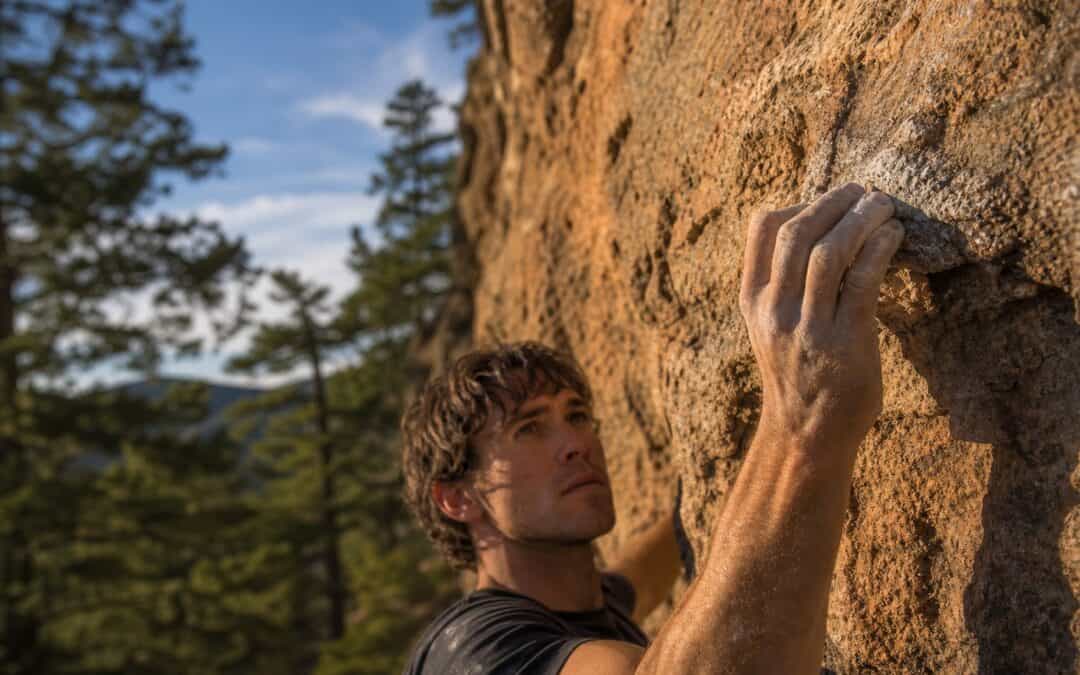
Denver and Boulder sit at the center of one of the best climbing regions in the country. Between Clear Creek Canyon, Boulder Canyon, Eldorado Canyon State Park, Red Rocks bouldering, and gyms like Movement and Denver Bouldering Club, climbers here train and send year-round — outside in the warmer months, on plastic when the passes ice over. That volume of climbing comes with a predictable cost: recent survey data on recreational climbers found that 77% report at least one climbing-related injury, and the vast majority of those injuries land in the fingers, hands, elbows, and shoulders.
If you’ve felt a twinge in your A2 pulley after a crimpy boulder problem, developed nagging medial or lateral elbow pain from repetitive pulling, or noticed your shoulder aching after a long day of sport climbing, you’re not alone — and you don’t have to stop climbing to get better. Here’s what the research says about the most common rock climbing injuries, and how a physical therapist can help you climb pain-free and stronger.
Why Climbers Get Hurt: The Numbers
A 2026 survey of 745 recreational climbers, published in a peer-reviewed sports medicine journal, found:
- 70% of climbers who reported an injury said it involved the fingers or hand
- 47% reported joint pain or swelling, and 47% reported a pulley injury specifically
- 14% reported a flexor tendon injury
- Injury odds were meaningfully higher among climbers who trained more frequently and at higher grades
Separate research on finger injuries found that the ring finger (50%) and middle finger (40%) are hurt most often, and that when a pulley is involved, the A2 pulley (63%) and A4 pulley (25%) account for the large majority of cases. This lines up with what we see in clinic: climbers showing up with a swollen, tender spot at the base of a finger after a dynamic move or a sudden slip off a small crimp.
Shoulders are the second major problem area, and often overlap with the kind of overuse patterns we treat at our shoulder pain clinic. Research on rock climbers describes rotator cuff tendinopathy, subacromial impingement, and SLAP (labral) tears as the most common shoulder injuries, particularly in climbers with poor scapular control or chronic overhead loading. One notable study comparing elite climbers with 25+ years of high-level climbing to non-climbing controls found distinct “climber-associated” patterns of shoulder joint changes — a reminder that shoulder health in climbing is a long game, not just a matter of avoiding one bad fall.
Common Rock Climbing Injuries We Treat
1. Finger Pulley Injuries (A2/A4)
The annular pulleys are small connective tissue bands that hold your flexor tendons close to the bone so you can crimp and hang without your tendons “bowstringing” away from the finger. A2 pulley injuries range from a mild strain to a partial or complete rupture, usually caused by a sudden, forceful crimp grip — often on a small hold, mid-dyno, or during a slip.
What the evidence supports:
– Grade I–II pulley injuries (strain to partial tear) are typically managed conservatively — rest from crimping, edema control, taping for support, and a graded return-to-load program — with many climbers back to full climbing within 6–8 weeks
– Full ruptures with bowstringing (a visible gap between tendon and bone) may need a hand specialist referral, but even many of these recover well without surgery
– A structured reload program matters more than rest alone: research on hangboard training shows that low-intensity hangs performed for more repetitions build finger tendon and pulley capacity with a lower injury risk than jumping straight back into high-intensity crimping
– Taping can offload the injured pulley during the return-to-climb phase, but it should never be tight enough to cause numbness, tingling, or color change
2. Shoulder Impingement, Rotator Cuff Tendinopathy, and SLAP Tears
Overhead reaching, campusing, and dynamic movement all load the rotator cuff and labrum repeatedly. Add in climbers who spend hours at a desk with rounded shoulders between sessions, and you get a setup for impingement: pain reaching overhead, into a high side-pull, or lock-off position.
What helps, based on current research:
– Manual therapy combined with scapular strengthening and stretching improves pain, range of motion, and function in shoulder impingement — better than exercise alone in several randomized trials
– Most rotator cuff tears, including many full-thickness tears, respond as well to structured physical therapy as they do to surgery in the medium and long term — surgery isn’t the default first step
– Because climbing rewards internal rotation and pulling strength, most climbers are relatively weak in scapular retraction, external rotation, and posterior cuff strength — the exact muscles a good rehab and prevention program targets
If you’ve been told you have a labral tear or rotator cuff issue and you’re not sure whether you need surgery, our team has written in depth about when you can avoid rotator cuff surgery and how grip and rotator cuff strength work together to protect the shoulder.
3. Elbow Tendinopathy (“Climber’s Elbow”)
Medial and lateral elbow pain shows up frequently in climbers who train hard on crimps and slopers, or who ramp up training volume too quickly after time off. This is functionally similar to what we see in tennis and golf-related elbow tendinopathy, and it responds to the same evidence-backed approach: load management, progressive tendon-specific strengthening, and (when appropriate) dry needling. If elbow pain is limiting your climbing, we’ve written about how dry needling and manual therapy help tendinopathy more broadly.
The Denver Factor: Training Load and Altitude
Front Range climbers face a unique training pattern: intense outdoor pushes on weekends at Clear Creek, Boulder Canyon, or Eldo, layered on top of gym sessions during the week — often with big jumps in volume when conditions finally line up after a stretch of bad weather. That “boom and bust” loading pattern is one of the strongest predictors of overuse injury in climbers, because tendons and pulleys adapt to load gradually, not in weekend spikes.
Altitude adds another layer: many Front Range climbers also hike or scramble approaches at elevation, and general deconditioning from time spent below altitude can mean showing up to a route already fatigued, which changes movement quality and increases injury risk on the rock itself.
How Physical Therapy Helps Climbers
At RISE, we work with climbers the way we work with any sport-specific athlete: build a full picture of your grip and pulley capacity, shoulder and scapular control, and overall training load, then build a plan that gets you back on the wall — usually while you’re still climbing, not after you stop entirely. That typically includes:
- Manual therapy and dry needling to address acute pain and tissue restriction
- A graded, load-based return-to-climbing program specific to your injury (not generic “rest and ice”)
- Scapular and rotator cuff strengthening tailored to climbing-specific positions
- Grip and finger-loading progressions using dynamometry and hangboard protocols
- Training load guidance so you stop cycling through the same overuse injury every season
If you’re dealing with finger, elbow, or shoulder pain that’s limiting your climbing — whether it started this week or has been nagging for months — a thorough evaluation makes the difference between guessing and knowing exactly what to load, what to rest, and how fast you can safely progress. Our approach is grounded in the same research cited above, not generic advice.
Frequently Asked Questions
How do I know if I have a pulley injury versus just a sore finger?
A pulley injury usually causes a sharp, localized pain at the base of the affected finger (most often the ring or middle finger) right at the moment of a hard crimp or slip, sometimes with a “pop” sensation, followed by swelling and tenderness that lasts for days. General finger soreness from volume tends to be more diffuse and improves quickly with rest. If you have focal swelling, bruising, or the finger looks like it’s bowing away from the bone under load, get it evaluated before climbing on it again.
Can I keep climbing with a mild pulley strain?
Often yes, with modification. Mild (Grade I) strains typically respond well to taping, avoiding open-crimp positions, and a graded reload program rather than complete rest. Pushing through pain on the same grip style that caused the injury is the most common way a mild strain becomes a partial tear, so working with a PT to modify your climbing and structure your reload is worth it.
Do I need surgery for a rotator cuff tear from climbing?
Not necessarily. Research shows many rotator cuff tears — including some full-thickness tears — respond as well to structured physical therapy as to surgery over the medium and long term. The right call depends on your specific tear, your goals, and how you respond to a trial of rehab, which is exactly what an evaluation is for.
How long does it take to return to climbing after a finger pulley injury?
For Grade I–II injuries managed conservatively, many climbers return to full climbing within 6–8 weeks with a structured, progressive reloading program. More severe injuries, especially full ruptures, may take longer and occasionally need a hand specialist referral.
What can I do now to prevent these injuries?
Manage your training load so you’re not spiking volume after time off (the classic “first nice weekend of the season” injury), build rotator cuff and scapular strength to balance out heavy pulling volume, and use lower-intensity, higher-rep hangboard training to build finger and pulley capacity rather than jumping straight to max-intensity crimping.
Dealing with finger, elbow, or shoulder pain that’s keeping you off the wall? RISE Rehab and Sport Performance offers 1-on-1, 60-minute evaluations with a Doctor of Physical Therapy who can pinpoint what’s actually going on and build a plan to get you back to climbing stronger. Book a discovery call or evaluation today.
READY TO GET BACK TO WHAT YOU LOVE?
Talk to a Denver Sports PT — Free
1-on-1 care with a Doctor of Physical Therapy. No referral needed.
Book a free 20-minute discovery call today.